So if you’re just joining us, I wrote a piece recently making the ever-so Paedobaptist point that the Christian’s children are in the new covenant. This is run-of-the-mill Paedobaptist stuff. But, as James has detailed, it doesn’t square with the Credobaptist position. It requires that some of the theological furniture gets moved around if you have been steeped in the deep waters of Credobaptism, and that remodel will most likely end with water on the little babes so, reader beware.
James White responded to my original post here. I replied to him here. He has replied to my reply in several installments, which can be found on the Alpha and Omega Ministries YouTube channel. As James noted, and I am thankful he noted this because I was starting to sweat the proverbial bullets, it will be hard to respond at length to James since his replies tally up to more than a couple hours, and those replies are in video format, not written. But, I do think a word on my end might help to move the ball down the court a bit more. While I don’t think we will have solved the Credobaptist/Paedobaptist question, we may be clarifying a few things for some. Plus, this reply affords me the opportunity to thank my friend James White for the engagement.
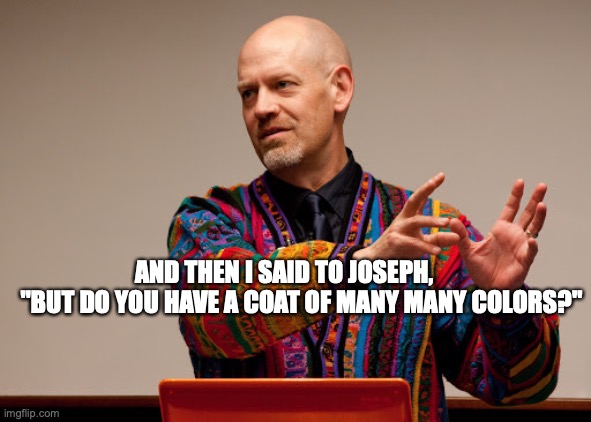
At one point, James explained how unfair he was being to me given that I do not have a multicolored light shining behind me in my videos and I do not have those lovely sweaters he wears, those that would make Joseph himself forget the offenses he suffered and turn to throw James in a pit for jealousy. I agree with James entirely that if you end up siding with him in this exchange it is most certainly due to those snuggle hug coogii he wears, and not because you agree with him on the intricacies of the Greek εἰς τὸ παντελὲς (Hebrews 7:25). Very sneaky those coogii.
A brief word of gratitude here before jumping in. I am grateful for the back and forth from James on this matter, and I am particularly grateful for the manner of the engagement. James noted before that he can disagree with me and others out here in Moscow without the debate getting fleshly. That is true, a grace from God, and a model to others in an age of people getting Moscow moody.
Boiling the Thing Down
The best I can tell, James’ replies boil down to two items: the nature of the new covenant and the nature of Christ’s mediatorial work. I am not surprised that the dialogue turns to these two doctrines as I think the Paedobaptists and Credobaptists have slightly different takes on both. Notice that word slightly. There is broad agreement on both. But there are differences. I will address the nature of the new covenant by means of the covenant of grace in this post, and I plan to do the same for Christ’s mediatorial work in a future one.
The Nature of the (New) Covenant of Grace
I provided a brief definition of the covenant of grace in my last reply to James. That definition serves as a definition of the new covenant as well. I would add accidental distinctions for a full definition of the new covenant. But again, the definition I’ve supplied for the covenant of grace suffices just fine for a general definition of the new covenant. Given that the nature of the new covenant is a sticking point, I will enlarge that definition of the covenant of grace below. This is important because James says, “from the least of them to the greatest” (Jeremiah 6:13-4; 31:34; Hebrews 8:11) necessitates that each and every member of the new covenant is regenerate. I disagree. And the definition of the covenant of grace and new covenant lurks behind our disagreement. The Credobaptist will certainly still have questions after reading what follows. But, a full description of the nature of the covenant of grace is foundational to the ongoing dialogue between Paedobaptists and Credobaptists. Now, for a full definition.
The covenant of grace is the Heavenly Father’s solemn oath to man on earth of grace, salvation, and life in and by Jesus Christ, conditioned upon obedient faith, that constitutes a legal and relational bond in blood, a community, and/or an organization over and to which God says, “I am y’all’s God and y’all are my people.” Thank you for putting up with my Southern ways. I would note the genius of the Southern folk at this juncture, given that they came up with a word for the second person plural. A most excellent achievement.
That definition is full and it needs to be supported from Scripture, but there is a lot of text to cover. The word “covenant” appears 284 times in the Old Testament, and it appears 33 times in the New Testament. I won’t cover every appearance of course, but we will examine a few below. But first an illustration.
This covenant of grace is like an ice cream shop. Christ himself is the ice cream in this ice cream shop, “Taste and see that he is good” (Ps. 34:8). God serves ice cream in the ice cream shop. This is simply the way he has chosen to go about it. God’s banner over this ice cream shop is directed to all those inside and it reads, “I am y’all’s God and y’all are my people.” When a man calls upon the name of the Lord, he enters the ice cream shop, and his household comes with him into the ice cream shop. And yes, it is true that not every person in this ice cream shop is actually eating the ice cream.
From the time of our fall in our father Adam, our God set up this gracious ice cream shop in which he served his people Christ, the ice cream. Ice cream eating, genuine and saving communion with Christ that is, has always been by faith. At the coming of Christ in the flesh, he established a new form of this ice cream shop (the new covenant). Christ established a new ice cream shop structure over the old and the old has passed away. So there has only been one true ice cream shop throughout history, but there was a genuine change in the structure of this establishment and its administration (the new covenant). Whether it be the old model or the new, this ice cream shop has served the same ice cream (Christ), housed the same people (covenant members), and it has always been a family- friendly establishment (i.e. when a man enters to eat the ice cream, his household comes into the shop with him).
American evangelicals by and large envision not an ice cream shop, but an ice cream stand in the street. Jesus is being preached at this ice cream stand. Christ, the ice cream, is being served up, and individuals either eat or do not eat. But, no shop. On the one hand, this ice cream stand approach is not the end of the world. You still have the ice cream (Christ). And you have individuals eating or not eating. On the other hand, in this ice cream stand arrangement, any concept of covenant gets folded into merely eating the ice cream as an individual. To be in covenant with God is simply to eat the ice cream. Covenant is only an individual matter and covenant is reduced to God’s effectual call of an individual in the order of salvation. Covenant becomes simply God getting thing A to individual B (the ice cream to an individual eater). This notion falls short of a biblical definition of the covenant of grace.
Now, consider a few things about the definition above.
First, I’ve made the point that it is the Heavenly Father who covenants with man on earth. That is because a divine covenant with man is executed in history. What is in view is not a platonic covenant. It is not the idea of a covenant. It is not a covenant up in the heavens. A covenant is cut. Covenants must be established or they are not divine covenants with man. You have no divine covenant with man if you don’t have a bond in blood. Blood and people are essential ingredients in the covenant of grace. So the heavenly and earthly language, as well as the blood language, is a reminder that covenants originate with God in heaven and they are executed down here on earth with man. God’s dealings with Abraham in Genesis 15 constitutes a clear example. The blood of the slain animals signals an intense and formal covenant established.
Second, the covenant of grace involves the creation and formation of a constituted people. Theologians often use the language of administration, and that is fine language, but many can mistake such language to mean “getting thing A to individual B,” as in “I administer lotion to my daughter’s knee.” That idea does not capture what is involved in the word administration. Rather, think of how we use the word administration when we refer to the Washington or Jefferson administration. The Washington or Jefferson administration refers to an entity, a people, an organization, a corporate reality. You can be a member of such an administration or not a member of such an administration. It sounds strange to speak of being a member of a covenant if a covenant is nothing more than God’s promise to an individual. You might say that you are a believer of the covenant. But covenant membership implies that a covenant is more than a promise, it is an administration, organization, or league. Membership in an administration involves rights and responsibilities. None of that comes through when we conceive of a covenant as a mere promise from God to an individual. Now, God makes promises to individuals. I’m not disputing that he does. I’m saying that to reduce covenant to such a notion is to do injustice to the covenant idea.
Third, the covenant of grace involves a relationship between God and his covenant people. I’ve moved out of the South, but having lived my whole life there I’ve reflected with a chuckle about how the corporate operated in speech. Growing up, if you saw some friends out and about, you’d likely ask, “How y’all doing?” And when you asked the question, you were not only thinking about the people in front of you. Your friends were in view, yes, but if they were there, their folks were in view too: parents, grandparents, kids, and grandkids. That’s a covenantal way of thinking. So the point to emphasize here is that the covenant of grace concerns man on earth, a real organization, and that organization or entity is not merely an individual, or even a collection of individuals, but one new man. We hear about this one new man in Ephesians 2:15, “Having abolished in his flesh the enmity, even the law of commandments contained in ordinances; for to make in himself of twain one new man.” Interestingly, that text employs the same language we hear when God joins a man and woman together in covenant marriage.
Fourth, the covenant of grace maintains an eschatological orientation. It is not a static thing. It is the solemn oath of grace and life in and by Jesus Christ. But that does not mean that the covenant of grace only has in view your personal justification. Jesus came to save the world— “For God sent not his Son into the world to condemn the world; but that the world through him might be saved” (John 3:17). The covenant of grace regards the promise of the Father of grace, the increase of grace, grace upon grace, grace to the ends of the earth. Now, does this definition (and the ice cream shop illustration above) hold up?
Well, we might start by looking at a definition of the Hebrew word for covenant. One Hebrew-English lexicon defines covenant as an “alliance of friendship” and “a divine constitution or ordinance with signs and seals” between God and man.[1] As noted before, this definition of covenant entails more than a promise. Alliance, league, and constitution are hovering right there at the heart of what a covenant is. We see something similar in the New Testament Greek word for covenant. A good Greek-English lexicon defines covenant as “last will and testament.” Covenant involves God determining what to do with what is his, “You are my people, and here is what is going to happen with you.”
As I mentioned before, the covenant of grace is found throughout the Scriptures. And the context in which it is used sheds light on the nature of God’s covenant of grace. The friendship or relational sense comes through in Psalm 25:14, “The secret of the Lord is with them that fear him; And he will shew them his covenant.” Here I would quibble with those who want to describe the covenant of grace in merely legal terms. The covenant of grace indeed has legal dimensions. But claiming that the covenant of grace is merely legal and not relational in any sense simply does not square with Scripture. David says that God will reveal his covenant to those who fear him like a friend shares a secret with his companion. When God covenants grace to Abraham, he promises “to be God unto thee, and thy seed after thee” (Gen. 17:7). That is relational language.
The corporate, constitutional, and eschatological dimensions of the covenant of grace are seen in a text like Genesis 9:8-9, “And God spake unto Noah, and to his sons with him, saying, ‘And I, behold, I establish my covenant with you, and with your seed after you.’” God does not only make this covenant with Noah. He speaks unto Noah and to his sons with him. The covenant is corporate, involving more than the individual. Moreover, God’s covenant maintains an eschatological scope, for God will establish his covenant with Noah’s seed after him. The constitutional dimension of the covenant is seen in that God says he will establish his covenant with Noah. God is not simply making a promise to Noah. He is establishing a people to whom a promise is made.
We see these same things in God’s covenant with Abraham. Genesis 15:18 says, “In the same day the LORD made a covenant with Abram, saying, Unto thy seed have I given this land, from the river of Egypt unto the great river, the river Euphrates.” Again, God’s covenant is not merely with Abram, but Abram’s seed; thus it is corporate and familial in nature. Also, the covenant involves a bond: God “made a covenant with” Abram. He was not merely delivering a promise to Abram, he was establishing a bond with Abram and his seed. Similarly, the earthly component is seen in that God made covenant with Abram in a certain day, thus the covenant was historical in nature. And it, of course, was made with Abraham on earth.
Covenant Households and the Covenant of Grace
We now have a definition of the covenant of grace. And we already have indicators lighting up the dashboard signaling that when a man enters the covenant of grace his household comes with him into that covenant with God. I have made that assertion above. That is not a novel claim. Herman Bavinck for example has said that the covenant of grace “is never made with a solitary individual but always also with his or her descendants. It is a covenant from generations to generations. Nor does it ever encompass just the person of the believer in the abstract but that person concretely as he or she exists and lives in history, hence including everything that is his or hers. It includes him or her not just as a person but him or her also as father and mother, as parent or child, with all that is his or hers, with his or her family, money, possessions, influence, and power, with his or her office and job, intellect and heart, science and art, with his or her life in society and the state.”[2]
This claim that the covenant of grace “is never made with a solitary individual but always also with his or her descendants” makes sense given the definition of the covenant of grace above. The claim does not make sense if one reduces the covenant of grace to effectual calling or personal regeneration. In that case, Bavinck’s claim would be that your descendants are regenerated by God upon your regeneration. And the good Calvinists know that once regenerated, never unregenerated, lost, or condemned. It would follow, under the “covenant of grace equals regeneration” scheme that all natural descendants of the regenerate would be robotically, mechanically, or automatically regenerate. James mentioned this problem in one of his replies. But, again, the definition of covenant of grace detailed and supported above demonstrates that the covenant of grace cannot be reduced to simply God’s effectual call.
A good man might still well say, “OK, I see that God’s covenant of grace is historical not ideological, corporate not strictly individual, relational not simply legal, and eschatological in that it concerns seed. But how can I be sure that God’s covenant promise concerns the children of my household such that when I enter into this covenant my children do too?” One response to this well-received question is to say that all of God’s covenantal dealings with man in the covenant of grace include their children. The chief example is Abraham.
God covenanted the following to Abraham: “And I will establish my covenant between me and thee and thy seed after thee in their generations for an everlasting covenant, to be a God unto thee, and to thy seed after thee” (Gen. 17:7). This covenant is not superficial, physical, or sub-salvific in nature. God covenants to be God to Abraham’s children. God immediately adds the following words to Abraham, “Every man child among you shall be circumcised. And ye shall circumcise the flesh of your foreskin; and it shall be a token of the covenant betwixt me and you” (Gen. 17:10-11).
God told Abraham that he would be God to his children. And he told him to give those children the sign of that covenant. They were signed and sealed members of the covenant that God made with Abraham. And that covenant promised that God would be their shield and their great reward (Genesis 15:1), indeed that He would God to them (Genesis 17:7). Now these covenant children of Abraham would have to follow in the footsteps of their father. They must keep covenant and the covenant has always been kept by faith. But they clearly grew up as insiders and not outsiders; they were marked with the covenant sign because they were covenant members and God said to them, “I am your God and you are my people.” The same holds true for us today who are children of Abraham. The promises are to us and our children as they were to Abraham and his.
The payout of this description of God’s covenant of grace is this. As a faithful Credobaptist, James says that “from the least to the greatest” indicates that regeneration is definitional of the new covenant. But the nature of the (new) covenant of grace that I’ve detailed above is such that drawing that conclusion becomes a heavier lift because covenant children have always been included in God’s covenant of grace.
[1] Francis Brown, Samuel Rolles Driver, and Charles Augustus Briggs, En- hanced Brown-Driver-Briggs Hebrew and English Lexicon (Oxford: Clarendon Press, 1977), 136.
[2] Herman Bavinck, Reformed Dogmatics, vol. 3, Sin and Salvation in Christ, ed. John Bold and trans. John Vriend (Grand Rapids: Baker Academic, 2006), 230.